












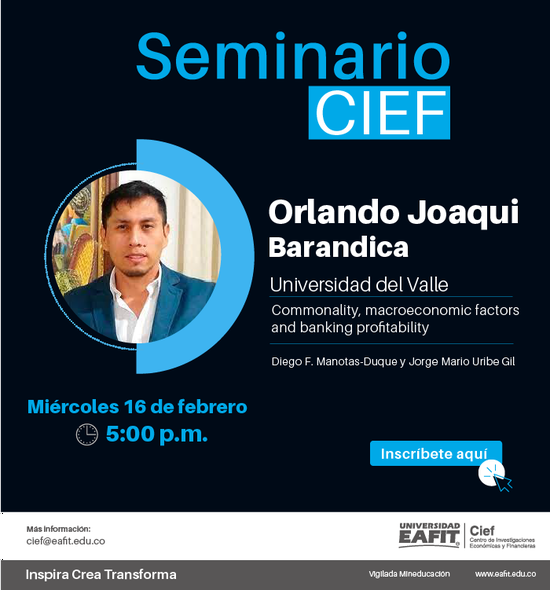


Orlando Joaqui Barandica

Orlando Joaqui Barandica

PhD Industrial Engineering

Universidad del Valle

Hi, I’m Jr!

I’m a Ph.D. in Engineering with a focus on Industrial Engineering from Universidad del Valle, where I also earned my degrees in Statistics and Applied Economics. Currently, I’m an assistant professor at Universidad del Valle, where I lead courses in statistics, econometrics, business analytics, machine learning for finance, data visualization, and quantitative finance.

Throughout my academic journey, I’ve collaborated with several leading universities in Colombia, including Pontificia Universidad Javeriana Cali, Universidad ICESI, Universidad San Buenaventura Cali, and Universidad del Tolima—sharing knowledge and training students in areas at the intersection of data and finance.

My research explores the dynamics of energy markets and energy finance, as well as quantitative approaches in business analytics, risk management, and econometrics. I’ve published in specialized journals on energy and finance, contributing to the development of data-driven insights that inform policy and business decisions in complex, evolving environments.

Download my resumé.

Interests
  • Energy Finance
  • Business Analytics
  • Quantitative Finance
  • Applied Econometrics and Statistical
  • Data Science and Data Visualization
Education
  • PhD in Industrial Engineering, 2023

    Universidad del Valle

  • MSc Applied Economics, 2017

    Universidad del Valle

  • BSc in Statistics, 2014

    Universidad del Valle

Skills

… and many other packages !!

Experience


Universidad del Tolima
Assistant professor
Jul 2021 – Oct 2021 Ibagué - Colombia

Guide and develop the classes of the courses:

  • Data visualization in R
  • Reports in RMarkdown


Universidad de San Buenaventura Cali
Assistant professor
Jan 2019 – Jul 2019 Cali - Colombia

Guide and develop the classes of the courses:

  • Econometrics I
  • Econometrics II


Universidad Santiago de Cali
Assistant professor
Sep 2018 – Sep 2018 Cali - Colombia

Guide and develop the classes of the courses:

  • Techniques and data analysis


Universidad ICESI
Assistant professor
Aug 2016 – Aug 2019 Cali - Colombia

Guide and develop the classes of the courses:

  • Probability theory
  • Statistical inference
  • Regression and sampling


Universidad del Valle
Assistant professor
Aug 2016 – Present Cali - Colombia

Guide and develop the classes of the courses:

  • Econometrics
  • Analysis of social and economic data in R
  • Data processing
  • Statistical methods
  • Time series and forecast
  • Multivariate analysis and data mining
  • Analytics applied to finance
  • Data management
  • Applied statistics I
  • Probability and statistics


Pontificia Universidad Javeriana de Cali
Assistant professor
Jan 2016 – Present Cali - Colombia

Guide and develop the classes of the courses:

  • Descriptive statistics
  • Statistics I
  • Quantitative methods for finance
  • Mathematics and statistics for economic sciences
  • Quantitative methods applied to social policy


CIAT - The International Center for Tropical Agriculture
Statistician - Visiting Reasearcher
Jun 2014 – Dec 2014 Palmira - Colombia
Manipulation and statistical analysis of cassava breeding databases.

Recent Posts

Recent Publications

2026

Energy transition shocks and tourism resilience in Spain: A quantile connectedness analysis (2019–2024)

TOURISM ECONOMICS

2026 - *(with Heredia-Carroza, J., López-Estrada, S., Parra-López, E.).* '**TOURISM ECONOMICS**'

Full Publication
Abstract

This study analyzes the dynamic interdependence between tourism activity, energy transition variables, and macroeconomic uncertainty in Spain from 2019 to 2024. Using a Quantile Connectedness Approach based on a Quantile Vector Autoregression (QVAR) model, it captures asymmetric and state-dependent spillovers among tourism emissions, jet fuel and carbon prices, inflation, and uncertainty indicators. Results show that the tourism–energy nexus forms a highly interconnected system whose intensity varies across market regimes. During crises, energy and uncertainty variables dominate as shock transmitters, while in recovery phases, air tourism regains influence, supporting system reactivation. Jet fuel and carbon prices are key transmission channels linking tourism and macroeconomic volatility, with inflation and policy uncertainty amplifying effects. Carbon pricing evolves from a volatility source to a stabilizing mechanism as transition expectations consolidate. The findings highlight asymmetric resilience in tourism and provide insights into policies aligning tourism recovery with energy transition and climate goals.

2026

Global Monetary Conditions and Sovereign CDS Connectedness in Emerging Markets: A Quantile Network Approach

JOURNAL OF RISK AND FINANCIAL MANAGEMENT

2026 - *(with Peña-Vargas, V. A., Gómez-Daza, J. A.).* '**JOURNAL OF RISK AND FINANCIAL MANAGEMENT**'

Full Publication
Abstract

This paper examines whether global monetary conditions are embedded in the spillover structure of sovereign credit risk across emerging markets and whether that role changes across market states. Using monthly data for 15 emerging-market 5-year sovereign CDS series from March 2008 to February 2026, we construct a World Interest Rate (WIR) from the common component of shadow or policy rates in the United States, the euro area, Japan, the United Kingdom, Switzerland, and Canada. The empirical analysis is based on a rolling quantile vector autoregression connectedness framework applied to transformed CDS and WIR series. The results show that sovereign CDS spillovers are strongly state dependent. Total connectedness is already high at the center of the distribution, but rises markedly in both tails, producing a clear U-shaped quantile profile. The WIR is clearly integrated into the network, although not as a uniformly dominant transmitter. In central and intermediate quantiles it behaves mainly as a net receiver of spillovers, while in more stressed upper-tail conditions it becomes less absorbent and can occasionally shift into a mild transmitting role. These findings suggest that global monetary conditions matter within the sovereign CDS network, but in a conditional rather than uniform way.

2026

Financial resilience of electricity sector companies in emerging and developed economies: a comparative analysis during times of distress

QUANTITATIVE FINANCE AND ECONOMICS

2026 - *(with Manotas-Duque, D. F., Orozco-Cerón, O. W.).* '**QUANTITATIVE FINANCE AND ECONOMICS**'

Full Publication
Abstract

This study delved into the determinants of the financial performance of energy firms in both developed and prominent emerging markets, employing a comparative lens. By examining companies within the electric power generation, transmission, and distribution sectors in BRICS and G7 markets throughout the years 2018–2022, including the disruptive COVID-19 period, we leveraged the dual multiple factor analysis (DMFA) technique. Our analysis uncovered four key dimensions—asset-to-debt ratios, operational profitability, liquidity, and the interplay between growth and financial stability—providing clarity on over 65% of the sector’s financial dynamics. Our primary findings underscore discernible heterogeneity and emphasize the heightened resilience demonstrated by G7 firms, particularly during the pandemic era. The implications of these disparities carry significant economic and financial ramifications for both groups, influencing their response and recovery mechanisms in the face of disruptive shocks.

Contact